
This next instalment in my catch-up posts follows on from the Moskitian Adventures. It covers the ride south from Mocoron (Honduras) to (Granada) Nicaragua, a distance of some 800kms, most of which is on rough, remote dirt roads.
This seldom visited area of Nicaragua is known as RAAN – Region Autonoma del Atlantico Norte – and it’s home to a cultural melting pot of Creole, Mestizo and indigenous groups, including Miskitos. I had to detour into its capital, Puerto Cabezas, to get my passport stamped, as the immigration office was closed on the Honduran border.
A ramshackle, sketchy Caribbean port, Puerto Cabezas is infamous as a stop off for cocaine smugglers working their way north from Colombia. I don’t like to overdramatise things, but drug running is definitely a big part of life in these parts. The town felt fine during the daytime – plenty of friendly smiles and waves – but it’s not somewhere I’d feel comfortable roaming at night.
As an example, one Roatanian living in this area told me about a high speed chase with a blacked out US Apache helicopter, along the coast at night. He claimed in the right conditions, the boats – effectively superlight hulls with a row of outboard motors bolted onto the back – could do 80 knots. During the chase, he was unable to escape the beam of the Apache’s search light despite pulling his best moves, so finally had to ditch the boat and its cargo of cocaine on the beach and disappear into the night… ‘I don’t do that anymore. It’s too stressful now I have a family. I just build fibreglass boats in the peace and quiet of the forest…’

Loaded up and ready to leave Mocoron, where I’d been resting up for a couple of days. A huge thank you to Anita and Legia for teaching me how to open a coconut like a man, wash my clothes (properly) in a river, and all their laughter and smiles.

The girls saw me off with a few slabs of energy rich yukka coconut cake we’d made the day before.

Initially, the countryside felt strangely reminiscent of the forest trails in Montana. Crossing from Leimus into Nicaragua was straight forward – just a dollar for the crossing in a dugout – albeit under a heavy downpour.

Welcome to Nicaragua.

Not long into the ride, I met Stefan, a Romanian motorbiker who’d travelled down from Canada. We’d first bumped into each other in La Ceiba, from where he’d taken a cargo boat to Puerto Lempira. We ended camping out together and staying in the same cheap digs for the next few days.
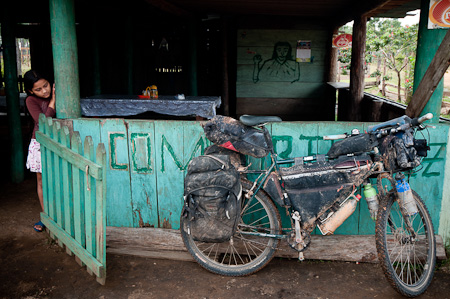
Stopping for a food in a Nicaraguan comedor as I entered RAAN.

The meal was one of the best I’ve had in a while – chicken, yucca, beans, rice and chopped tomatoes. It was all grown locally and tasted incredibly fresh. As I worked my way through the bowl hungrily, the owner of the comedor joined me, a farmer who ran the restaurant to help supplement his income. He’d seen a couple of touring cyclists pass by before and having chatted to them, had clearly been cogitating about bike touring. ‘Rare is the man who really knows the world. You can’t understand life from a car or plane. But on your bicycle, you see and experience everything,’ he said.

Local rural transport in Northern Nicaragua. A long way from Montgomery County, Maryland…

Red dirt. The road from Waspan to Puerto Lempira was mined with puddly potholes, thanks to the storms that kept rolling in above the vast, far reaching savannah.

On the road, and loving it. (photo taken by Stephan from his Kawasaki)

For several kilometres, I was joined by a local cyclist. We climbed an observation tower for an epic view of this part of La Moskitia. Compared to the singletracks I’d been negotiating in La Moskitia, these dirt roads felt like freeways.

Repairing a puncture by knotting it off – a technique I hadn’t seen before.

I kept playing tag with Stephan and his Kawasaki. Although he’d easily outpace me, he had some welding he needed to deal with, and his customs paperwork took longer to process.

My biking buddy’s home. I like the way it was partitioned for different members of the family. Very sensible if you’re living under one roof!

The approach to Puerto Cabezas – known as Bilwi in Moskitian – a sketchy port home to Moskitians, Colombian cocaine smugglers and only the most tenacious of Mormon missionaries.

A leatherback chopped up and swarming with flies in the market – not a particularly heart warming sight for a turtle lover, like me. Apparently, turtles that aren’t fully grown have to be thrown back in by law.

No shortage of bananas in these parts. The five stubs are the one I had for breakfast.

This local guy offered to show me around town, and we spent the afternoon together exploring some the backroads that linked Puerto Cabezas with nearby villages.

From Puerto Cabezas, I’d been told it was a rough and remote 560kms to the capital, Managua – and dirt all the way to Rio Blanco. To give you some idea how slow going it can be, it takes the bus 24 hours to cover that distance… That’s an average of around 23 kilometres an hour.

And here’s one such bus. Fast and Furious, reads the livery. That must be a relative term round here… We crossed one of the rivers together (on a boat tugged by a chain) and everyone on aboard gathered round to find out what I was up to, and wish me luck for the road ahead.

No wonder, with extended parts like this. If I put in some long days in the saddle, I figured I could make it in six days to colonial Granada, quieter and safer than the capital, and a little under 600kms away. It would mean some long (and painful) hours in the saddle.

This surface was some of the worst I’ve ridden over, with thousands of small yet jagged rocks embedded into the earth.

Every once in a while, the road rippled with short yet steep stunted hills that afforded views over the pine forest and savannah.

One night I slept on the floor of this cheerful, Evangelical pastor. I was too tired too be kept up by the rousing nighttime singalong.

Civilisation, in the form of the bustling metropolis of La Rosita, bringing with it the promise of a good meal and some fresh fruit other than bananas…

La Rosita was also home to some cool utility bikes concocted with motorbike parts.

Check out that fork used to brace the rear triangle. These cost around $200 and are made locally.

Hanging out at the local bike shop.

The road alternated from bad to really bad. This particular stretch rattled my brains and loosed my fillings. Not to mention giving me a sore backside. Sometimes I could seek rattling sanctuary from slivers of smoothish trail along the very edge of the road, riding faster than the transport trucks that deliver supplies to Puerto Cabezas.

The area felt settled in the daytime, but I was told to be off the road before nightfall. I didn’t run into any trouble, but I did pass through a small community close to Rio Blanco where three men had been held up killed just five days before, at three in the afternoon. ‘Are you worried about travelling along?’ was a question I was often asked. In fact, while I always received a warm welcome whether I went, the constant barrage of warnings crept into my subconscious and became unsettling.

The fine line between pleasure and pain. The odd kilometre or two was paved. But it was just that. One or two kilometres.

Try finding a way of pushing a fully loaded bike across this bridge… It’s like playing a game of Tetris.

I’d been told security on this part of Nicaragua can be an issue, so I either slept in cheap truck stop guesthouses, at 2 dollars a pop, or camped in villages and army check points.

Cowboy country.

Kids selling oranges by the roadside, which I gratefully guzzled down. When I went to leave, they gave me a handful for the journey.

The buses got to know me as they plied the route, and unleashed ear bleeding hoots of their horns to greet me. It’s the thought that counts…

In Rio Blanco, I saw this custom rack for carrying a gas bottle on the streets of Rio Blanco.

Adjustable in size too, depending on the brand of bottle.

NGO handywork – one of the many water pumps in RAAN. This area took a big hit in the Contra War, and there was evidence of bygone foreign aid programs all around.

Yep, one muddy bike…

And then, from Rio Blanco, the road was paved! Woohoo! As a dirt road enthusiast, for once I was actually glad to be rolling on pavement.

Blossoming trees by the roadside. These are called Guayacan.

I stopped off at this little hole-in-the-wall shop, and got chatting to Nora, who took a real interest in the journey. I asked to take a photo of her, and after accepting, she surprised me by asking if I had any photos of me and my bike. ‘Very few people will make a journey like this. It would be nice to remember our meeting.’

She got her daughter to climb the orange tree and pick me a bunch.

Nora’s pooches, lazing by her roadside shop.

Honey, sold by the roadside in Fleur de Cana recyled rum bottles.

Enormous avocados – perfect bike food.

After negotiating all the Mosquito Coast, culminating in this last six days of hard riding, I was less than an hour from my destination. It was with elation that I greeted this roadsign…

And Granada, less than an hour later… My Moskitian adventure was finally over. Epic is a world that’s thrown around a lot these days. This journey definitely felt like it justified it.


Amazing Cass, I can’t believe how resilient you are and yet so permeable in your ability to become one with your surroundings. I’ve never seen such intimate shots of this remote route like the ones you’ve captured-Epic!
I love the gas bottle rack – I saw ones like that in Cambodia years ago (but one for each side). The custom haul bikes are pretty interesting too, nice to see a bit of ingenuity like that.
But hey, lay off those avocados, I’m told they are very fattening 😉
Please continue to share photos of custom cargo bikes. The gas-bottle rack is genius!
Great to see some of the missing pieces to your journey. My favorite part of this entire entry is the quote from the farmer when you were enjoying your organic meal. What he said really seemed to me to be the essence of your trip and I imagined him speaking to your soul. I really liked the photo of the pastor. His mustache is AMAZING! I think you may want to consider growing one ;-). And lastly because I am a huge fan of children…I adore the boy selling oranges. Great photo Cass!
I think the “treciclo” is the next step for the family that outgrows their big dummy. a real “calorie guzzler” :). I’ve been seeing the bottle racks on bikes and motorcycles up here in Mexico too. They are usually using them for the drinking water 5 gallon jugs.
Keep up the great photos and stories!
Matt
Just read through all your posts up to this one from Río Dulce. VERY IMPRESSIVE! Looks like a monster adventure. I’ve realised that to do it I’d have to renew my visa, since Honduras and Nicaragua don’t count as leaving the country. Unless I can get to Costa Rica in 3.5 weeks on this route. Do you reckon that’s feasible?
On second thoughts, could be hellish in rainy season. do you reckon the dirt roads would be ridable?
Hey Nick. Yes, it’s not an advisable riding route in the rainy season. However, you could easily travel through the area by boat (no issues with the bike), perhaps even connecting Puerto Cabezas to the Corn Islands via the infrequent ferry.
where exactly did you find the honey, sold by the roadside in Fleur de Cana recyled rum bottles?
I’m afraid I can’t remember exactly where that photo was taken – it was some time ago. But I think it could have been 30 or 40km out from Granada.
I just returned from “Tasba Pri” (RAAN) , I have been visiting there since 1988 and the place has changed very little aside from twice as many people.
Never was a tourist place and probably never will be. I enjoyed your pictures very much , thanx for sharing
This was quite a rugged trip thru RAAN. I was a former teacher in Puerto Cabezas, and I traveled once from there to Waspan, on the dirt road on Honda 50 c.c. In the 1960’s. I admired all your pix, as I am also a photo buff. You are a brave soul to travel all alone!
Thanks for the message, Richard. Riding a 50cc Honda in the ’60s sounds pretty rugged too!
I wonder how much the area has changed?